As the film industry continues to evaluate the practical role of generative tools, a recent breakdown from BOT VFX offers a concrete look at how these technologies are being deployed in professional feature-length productions. For the historical war drama Young Washington, which follows the early military career of George Washington, the studio was tasked with delivering 300 shots within a tight 17-week window. To meet this demand without sacrificing the quality required for a period piece, the team implemented a hybrid AI VFX pipeline that merged traditional computer graphics with emerging generative workflows.
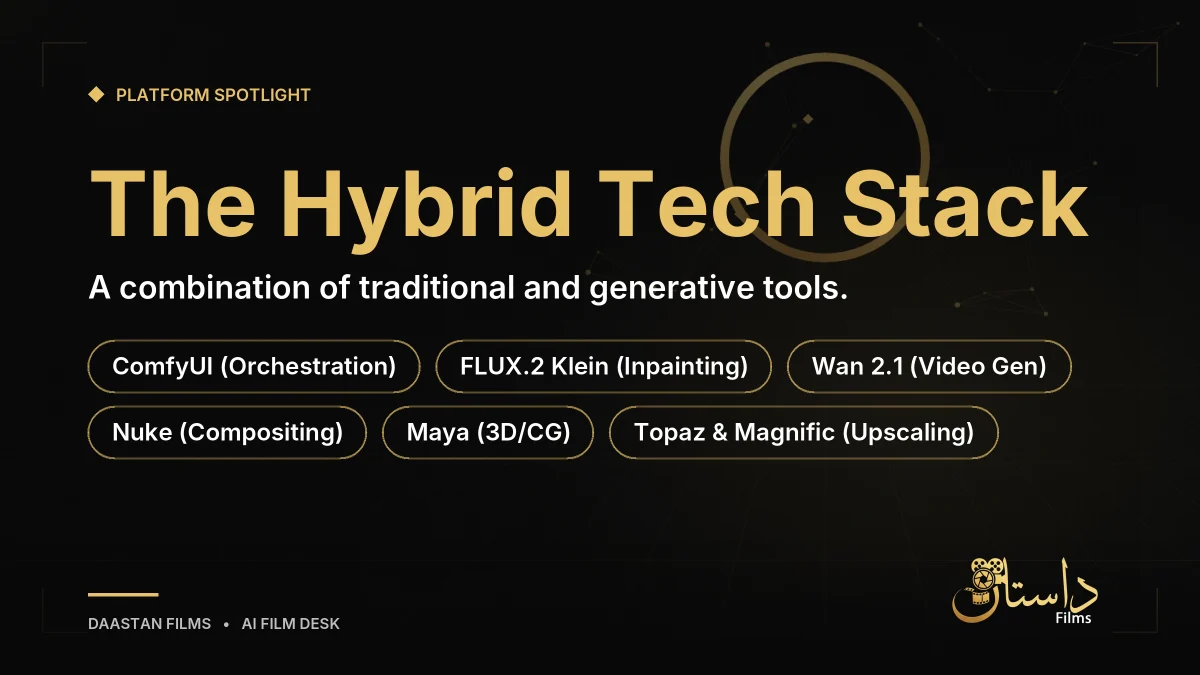
According to a report by CG Channel, the project involved a diverse array of visual challenges, from large-scale battle sequences to detailed historical environments. The studio did not treat AI as a replacement for its existing department structures. Instead, they utilized tools like Maya for 3D work and Nuke for compositing to refine and integrate elements generated by AI models. This approach allowed the studio to tackle complex shots that might have been impossible to complete within the allotted timeframe using only conventional methods.
The Architecture of a Hybrid Pipeline
At the center of BOT VFX’s strategy was an internal application built on ComfyUI. As VFX Supervisor Caine Dickinson explained to CG Channel, ComfyUI served as a node-based orchestration framework. This allowed the studio to manage and develop custom workflows, providing a structured environment for AI experimentation. By using a node-based system, the studio could more easily integrate generative processes into a pipeline that VFX artists, who are already accustomed to the node-based logic of Nuke, could understand and manipulate.
The studio primarily leaned on open-weight models for their core tasks. FLUX.2 Klein was used extensively for image inpainting, editing, and targeted refinement. For video generation, the team explored Wan 2.1. However, the pipeline was not limited to local models. With production permission, BOT VFX also utilized cloud-based solutions to access a broader range of capabilities. This included experimenting with models such as Kling, Kling Omni, Veo, Hailuo, PixVerse, and Seedance 1.5. This multi-model approach suggests that for high-end VFX, the goal is not to find one perfect tool, but to understand the specific strengths of each model for different shot requirements.
Solving the Resolution and Detail Gap
One of the most significant hurdles in using generative AI for feature film work is the resolution requirement. Most AI models generate imagery at lower resolutions, while modern productions often demand 4K delivery. BOT VFX addressed this by using a combination of Topaz Labs models and Magnific for image enhancement and upscaling. However, Dickinson noted that conventional upscaling was not always enough, particularly when the source material lacked fine visual detail.
In cases where simple upscaling failed, the studio turned back to their FLUX-based workflows. These workflows allowed them to reconstruct missing visual information rather than just increasing the pixel count. This distinction is vital for professional VFX: reconstruction involves generating new, contextually accurate details that match the surrounding plate, which is often necessary when the raw AI output is too soft or lacks the texture required for a 4K screen.
Refining Facial Details and Background Characters
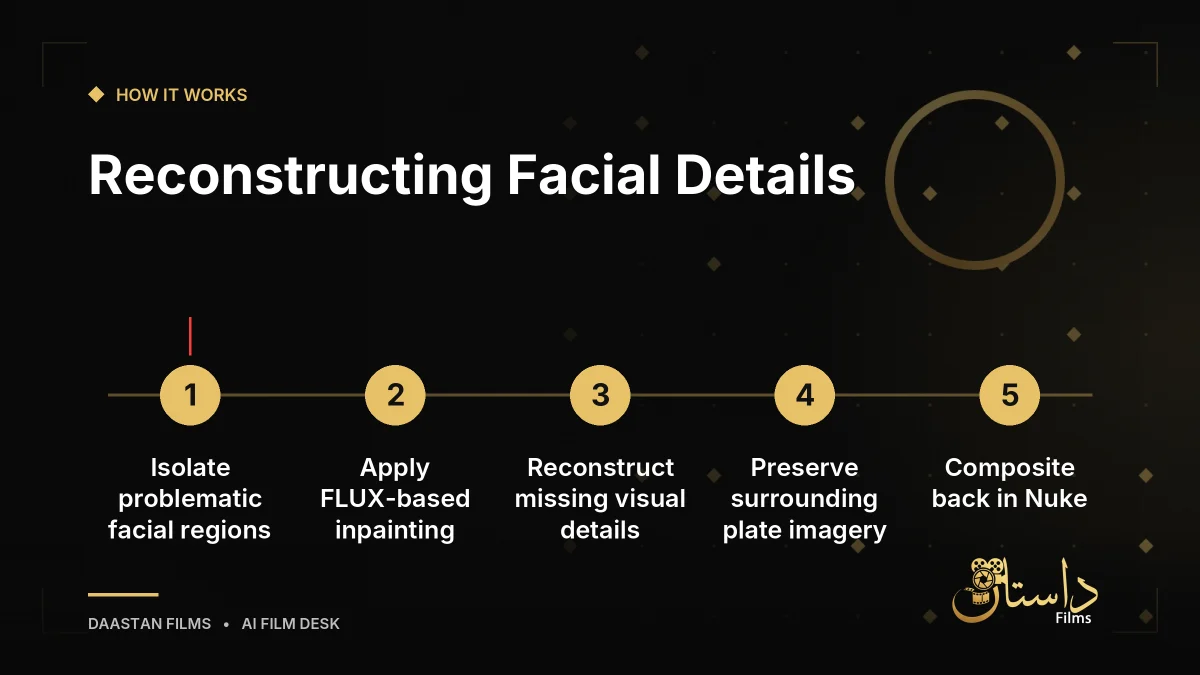
A recurring issue in generative video is the distortion of facial features, especially for characters in the background or wider shots. BOT VFX developed a specific workflow to solve this without the need to regenerate entire sequences. By isolating problematic regions of a frame, they used FLUX-based inpainting to reconstruct missing or distorted facial details. This allowed them to preserve the overall composition of the shot while fixing the specific elements that would otherwise break the viewer's immersion.
This surgical use of AI highlights the importance of the "hybrid" aspect of the pipeline. Rather than accepting a full AI-generated plate, the artists used traditional tracking, rotoscoping, and paint workflows to prepare the shots for AI intervention. Once the AI provided the refined details, the elements were brought back into Nuke for final compositing. This ensured that the AI-generated material adhered to the lighting, grain, and color space of the rest of the production.
Practical Limitations and the Need for Control
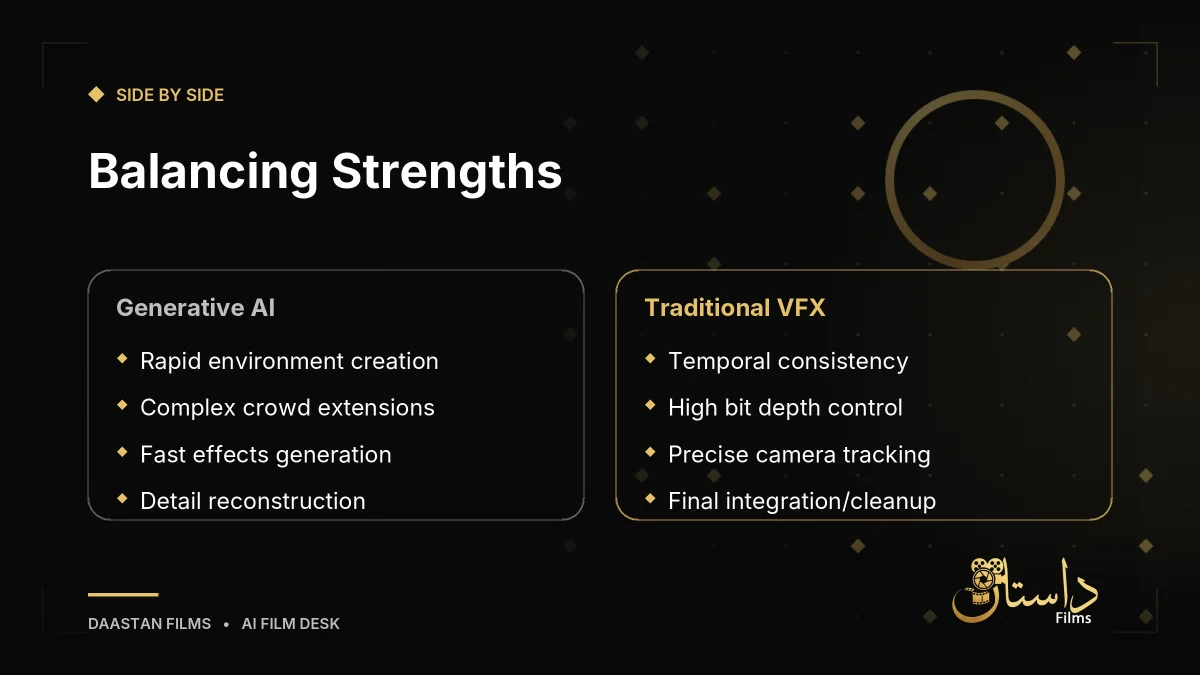
Despite the efficiency gains, BOT VFX is clear that generative AI is "not a magic bullet." The studio encountered several technical limitations that required traditional VFX expertise to overcome. Temporal inconsistency—where details shift or unwanted movement appears between frames—remains a major challenge. Raw AI output often requires significant cleanup to ensure it remains stable across a sequence. Additionally, the limited bit depth of some AI-generated material can reduce the flexibility artists have during the color grading and compositing stages.
The studio’s experience shows that different models excel at different tasks. For instance, some models might produce realistic camera movement but fail to maintain the identity of a character. Others might keep a character’s face consistent but struggle with fluid motion. By using a hybrid AI VFX pipeline, the studio could pick the best output for a specific need and then use traditional tools to bridge the gaps between different models.
Implications for the VFX Industry
The Young Washington project serves as a case study for how mid-to-large scale studios might navigate the transition to AI-assisted production. The success of the 17-week delivery suggests that AI can significantly compress timelines for environment extensions, crowd generation, and effects like muzzle flashes and explosions. However, the reliance on Maya and Nuke confirms that the core skills of a VFX artist—tracking, compositing, and aesthetic judgment—remain the foundation of the process.
For filmmakers, the takeaway is that AI is most effective when it is treated as a sophisticated brush rather than an automated filmmaker. The ability to generate town environments or mansion party scenes almost entirely with AI, as BOT VFX did, requires a deep understanding of how to augment those generations with digital matte paintings and CG elements. The control provided by traditional VFX techniques is what ultimately brings AI-generated elements up to a production-ready standard.
Ultimately, the integration of AI into professional workflows is a matter of problem-solving. Studios must develop novel ways to incorporate these tools while mitigating their inherent flaws, such as resolution limits and motion artifacts. As BOT VFX has demonstrated, the future of the industry likely lies in this balanced approach: using AI for speed and scale, while relying on traditional VFX for the precision and control necessary for cinematic storytelling.
Frequently asked questions
ComfyUI served as the node-based orchestration framework for the studio's internal AI application. It allowed the team to develop and manage complex workflows involving multiple different AI models.
They used Topaz Labs and Magnific for standard upscaling, but also utilized FLUX-based workflows to reconstruct missing visual details when simple upscaling was insufficient.
The studio noted that raw AI output often suffered from temporal inconsistency and limited bit depth. These issues required significant traditional cleanup and compositing work in Nuke to reach production standards.
Have a film, DVC or AI project in mind?
Daastan Films blends production, post-production and AI. Let’s talk about yours.