

Recent research from the University of Hong Kong has provided filmmakers with a fresh look at the global landscape of generative video tools. Evaluating 12 leading systems, the study placed ByteDance's Seedance 2.0 Pro at the top of the leaderboard for visual quality, outpacing prominent US-developed competitors. For creators navigating an increasingly crowded ecosystem of digital production software, these findings shed light on where different platforms excel and where they still face developmental hurdles.
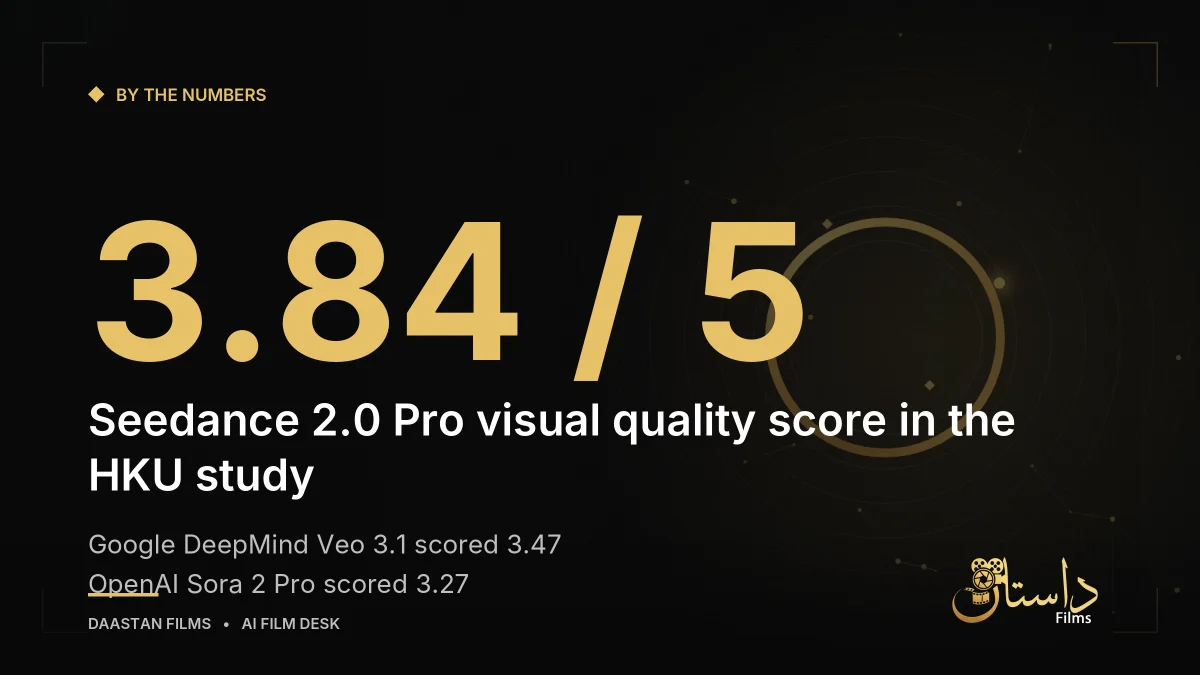
According to The News International, the evaluation was led by Zhenhui Jack Jiang, a professor of innovation and information management at the university's business school. The team tested model versions available in April using 71 Chinese-language prompts and feedback from 20 human evaluators. In the final tallies, Seedance 2.0 Pro achieved a visual quality score of 3.84 out of 5. This put it ahead of Google DeepMind's Veo 3.1, which managed 3.47, and OpenAI's Sora 2 Pro, which secured 3.27. Shengshu's Vidu Q3 Pro rounded out the top tier in third place.
When breaking down specific creative dimensions, Seedance also took the lead in visual consistency, physical realism, overall aesthetics, and adherence to user instructions. When evaluating video paired with sound, the ByteDance model maintained its front-running position with a score of 3.86, compared to 3.51 for Veo and 3.35 for Sora. ForkLog notes that Professor Jiang attributed this strong performance to ByteDance's ability to leverage its short-video business model to source large quantities of training data.
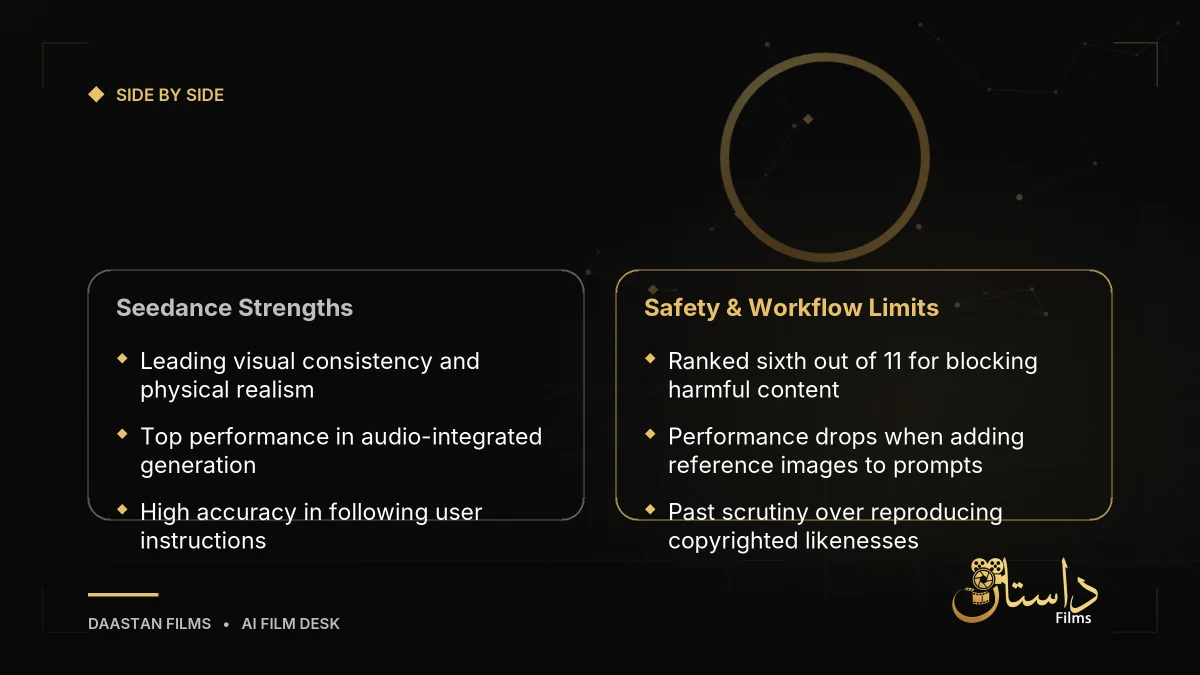
However, the study also highlights a critical trade-off that digital artists and producers must consider: the inverse relationship between top-tier generation quality and robust safety filters. While models performed impressively when rendering complex scenes, several generated illegal content when exposed to extreme violence and illegal acts. In safety evaluations testing how models handle misinformation, illegal content, violence, discrimination, and copyright infringement, Seedance ranked sixth out of 11 models with a score of 3.12. MiniMax's Hailuo 2.3 took the top spot for safety with a score of 3.63, while Veo 3.1 followed closely in second place with 3.62. Furthermore, safety scrutiny around Seedance has previously emerged after it reproduced copyrighted characters and celebrity likenesses, prompting ByteDance to establish an alignment and preparedness team and recruit safety researchers.
For independent filmmakers and studios assessing these tools, the research points to practical challenges in workflow integration. For instance, the study's authors observed that most tested models experience a drop in generation performance when creators add a reference image to a text prompt. For example, China's Wan 2.6 saw its evaluation score drop from 3.41 down to 2.75 when reference imagery was introduced. As the technology continues to evolve rapidly—with newer iterations like Seedance 2.5 launched in July, Kling 4.0 released in October, and Google's Omni updates rolling out—filmmakers must weigh the pursuit of striking visual fidelity against compliance, consistency, and safety guardrails.
Evaluating these generative systems requires a broad perspective on how global models handle complex visual sequences, audio synchronization, and prompt adherence. Creators analyzing the HKU study can observe clear performance divides between Chinese solutions and their Western counterparts. While platforms like Seedance 2.0 Pro deliver exceptional realism, aesthetic depth, and synchronized audio fidelity, production teams must also account for varying levels of content moderation and policy enforcement. As international developments continue to shape software releases, understanding these benchmark results helps directors and digital artists select the right tooling for specific project requirements.
Examining the broader implications for pre-production and concept generation, filmmakers should note that high evaluation metrics do not automatically eliminate operational friction. Prompt engineering strategies must account for how models react to multimodal inputs, such as reference images. Because reference materials can occasionally degrade generation scores—as documented in the Wan 2.6 testing—creators often achieve better consistency by relying heavily on detailed text descriptions rather than forcing mixed-media prompts. Balancing these technical realities ensures that editorial pipelines remain efficient while harnessing the highest possible fidelity from modern video models.
Additional context from the broader technology landscape shows that evaluating model robustness extends far beyond simple aesthetic scoring. As research teams continue to benchmark tools across diverse linguistic and cultural prompt sets, understanding the divergence between raw generative capacity and strict safeguard enforcement becomes essential. Directors working in international co-productions must carefully review local platform capabilities, licensing agreements, and content restrictions to avoid unexpected project delays or regulatory complications during distribution.
Furthermore, editorial teams must remain vigilant about how frequently these foundational video generation architectures receive updates. With developers continuously rolling out new versions—such as ByteDance's July introduction of Seedance 2.5 and Kuaishou's October release of Kling 4.0—benchmarks recorded during earlier testing windows can quickly shift. Maintaining an adaptive approach to software evaluation allows creative departments to harness cutting-edge visual aesthetics while remaining fully aware of evolving safety parameters, data governance standards, and technical limitations.
Frequently asked questions
According to a University of Hong Kong study, Seedance 2.0 Pro ranked first in visual quality with a score of 3.84 out of 5, outperforming Google DeepMind's Veo 3.1 and OpenAI's Sora 2 Pro.
Researchers attribute its leading performance in realism, aesthetics, and audio integration to ByteDance's ability to utilize its short-video business model for massive training data.
While strong on visual fidelity, many high-performing models lag in safety. Seedance ranked sixth out of 11 models for blocking harmful content, while MiniMax's Hailuo 2.3 and Google's Veo 3.1 scored higher on safety safeguards.
Have a film, DVC or AI project in mind?
Daastan Films blends production, post-production and AI. Let’s talk about yours.