Google DeepMind has introduced Google Genie 4 AI, a major update to its interactive world model that converts simple text prompts into explorable, photorealistic three-dimensional spaces. According to announcements covered by Techgenyz, India Today, and News Arena India, the research-preview model builds directly upon the foundation laid by previous iterations like Genie 3, moving beyond static video generation to offer real-time simulation and user interaction.
For filmmakers, developers, and researchers, the arrival of Google Genie 4 AI marks a distinct shift in how virtual environments can be prototyped. Instead of waiting for lengthy conventional video renders or building scenes entirely from scratch in traditional software, creators can prompt an environment into existence and directly influence its behavior on the fly. In practice, this means teams can explore conceptual spaces immediately, testing visual ideas before committing to heavy pipeline work. Examining how these systems operate helps industry professionals understand the wider implications for virtual production.
Understanding the context behind generative world models requires looking at how traditional pipelines function. Conventional video generators produce predetermined clips that cannot be modified mid-playback, forcing artists to re-render entire sequences whenever a creative adjustment is needed. By contrast, interactive world simulations generate pixels dynamically in response to incoming user actions. This structural difference alters the relationship between creator and tool, shifting the process from passive rendering to active exploration.
Understanding the Upgrades in Google Genie 4 AI
Traditional AI video systems generate fixed clips that cannot be altered once rendered. In contrast, Google Genie 4 AI allows users to actively interact with the simulated environment while it is running. The latest model introduces several core capabilities designed to enhance immersion and creative flexibility:
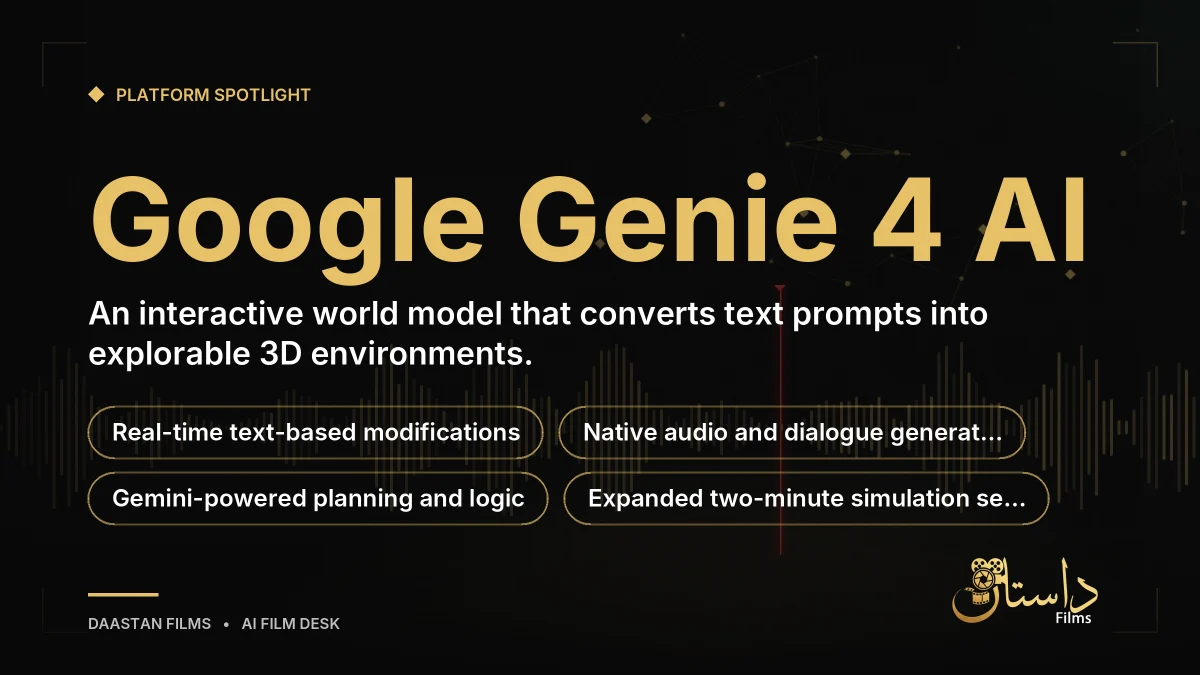
- Real-Time Text-Based Modifications: Users can issue natural-language instructions mid-simulation to alter camera angles, introduce weather effects such as rain, or add new objects and characters without stopping the process.
- Native Audio Generation: The system creates live environmental sounds, background music, and interactive dialogue that corresponds directly to visual events happening on screen.
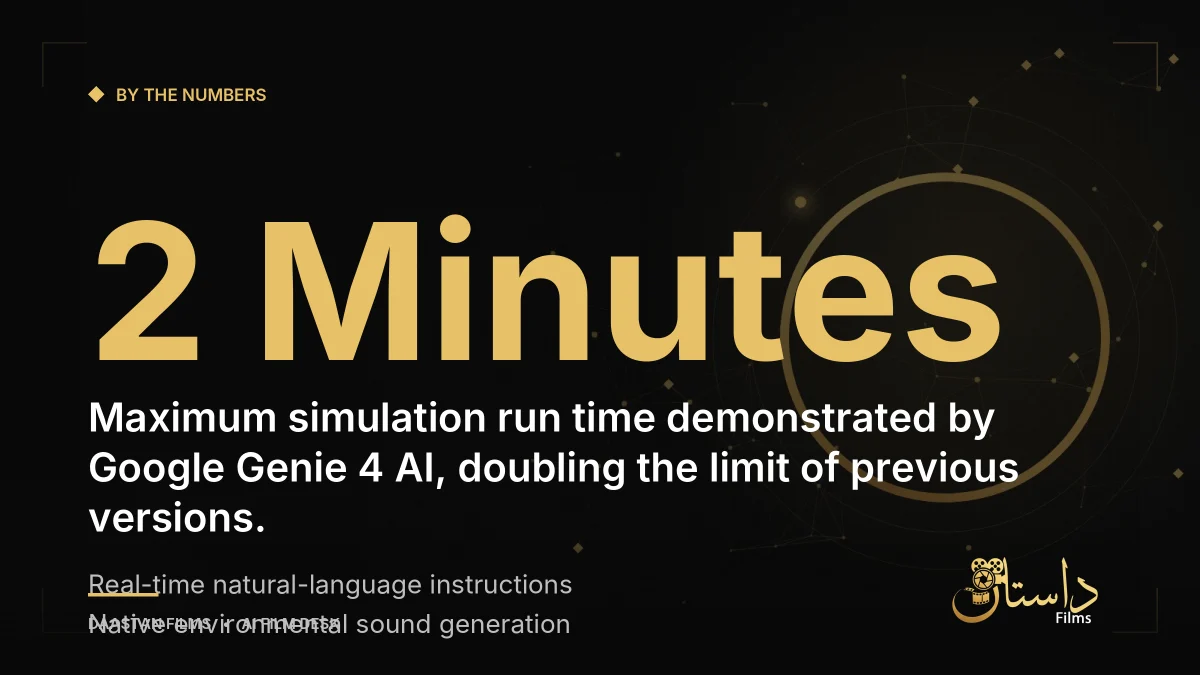
- Extended Simulation Duration: Demonstrations show simulations running for up to two minutes, doubling the exploration limit documented during earlier project phases.
- Improved Physics and Movement: Google reports better handling of character movement, collisions, and aerodynamics, creating more convincing real-time interactions.
As noted by Google DeepMind engineer Diego Rivas, these capabilities could transform previsualisation workflows for filmmakers by allowing rapid storyboarding that keeps creators in a seamless creative flow. Creators can experiment with lighting, camera movements, and scene designs dynamically without pausing to wait for rendering bars to clear.
Analysing these updates in practice reveals both opportunities and challenges for production pipelines. While the promise of real-time environmental adjustments is compelling for early-stage conceptual work, creators must remain aware of how these systems fit alongside established tools. The model does not replace traditional game engines like Unity or Unreal Engine, nor does it guarantee physically accurate simulations, but it introduces a novel layer for creative exploration and fast prototyping.
The Role of Gemini Integration
A major focus of the Google Genie 4 AI release is its deep integration with Google’s Gemini multimodal models. As explained by research director Tejas Kulkarni, future AI systems will increasingly rely on hybrid configurations where reasoning models and simulation models work in tandem.
In practice, Gemini acts as a strategic planning layer. It can interpret objectives, break goals into smaller steps, and establish the underlying logic and sequence of actions. Meanwhile, Google Genie 4 AI renders the corresponding visual environment. Experimental demonstrations have even paired Gemini 4 Argon with Genie 4 to simulate a humanoid robot playing checkers, illustrating how virtual spaces can be utilized to plan actions before physical testing. This combination of natural language reasoning and live visual simulation points toward new hybrid workflows across multiple disciplines.
For creative teams, combining language reasoning with visual simulation opens questions about how automated direction might influence pre-production. When a model like Gemini Omni or Gemini 3.8 Flash acts as a guiding agent—observing frames, breaking objectives down, and tracking progress—it changes how creators approach task breakdown. Although these features are currently demonstrated in controlled settings, they suggest a future where AI systems assist not only in generating assets but also in organizing project logic.
Access, Limitations, and Practical Cautions
While the technical achievements are notable, Google Genie 4 AI remains an early research preview with important constraints. Industry professionals should weigh these operational boundaries carefully before incorporating the technology into production pipelines:
- Restricted Availability: Initial access is rolling out to a small group of trusted testers, with broader availability planned for Google AI Ultra subscribers through Project Genie at $100 a month, alongside early-access developer options via the Gemini API and Google AI Studio.
- Simulation Drift: Engineer Diego Rivas noted that if a simulation runs for too long, the virtual world can begin to drift, causing objects to lose detail or disappear entirely.
- Inconsistent Physics: Although movement looks more realistic, realistic visuals do not guarantee physically accurate results, meaning the model cannot yet replace established game engines like Unity or Unreal Engine.
- Audio and Text Challenges: Developers are still actively working on perfectly synchronizing generated audio and rendering readable text inside the simulated worlds.
Security and provenance features such as Google’s SynthID watermarking are embedded to help identify AI-generated video and audio content, though watermarks do not verify physical accuracy. Creators must remain mindful of these boundaries when planning any creative pipeline, ensuring that generated scenes are not mistaken for verified representations of real-world conditions or physical facts.
Looking Ahead
Google Genie 4 AI highlights the rapid acceleration of generative world-building technologies across the industry, entering a competitive landscape that includes tools like Runway's GWM Worlds 2. While filmmakers can look forward to rapid storyboarding and game developers can explore visual concepts early in development, the technology is currently best viewed as a promising research tool for creative exploration rather than a dependable replacement for standard production toolchains.
Frequently asked questions
Google Genie 4 AI is a research-preview world model developed by Google DeepMind that transforms simple text prompts into photorealistic, interactive three-dimensional spaces that users can explore and modify in real time.
Filmmakers can use the model for rapid storyboarding, allowing them to test camera movements, lighting, and scene designs during previsualisation without waiting for lengthy traditional video renders.
The model is currently available to a small group of trusted testers, with plans to roll out access to Google AI Ultra subscribers through Project Genie and to developers via the Gemini API and Google AI Studio.
Have a film, DVC or AI project in mind?
Daastan Films blends production, post-production and AI. Let’s talk about yours.