Google has officially launched Gemini Omni 1.2 Flash, delivering longer native clips, multi-turn conversational editing, and a 30 percent reduction in video generation costs. According to Google's announcement, the upgraded multimodal model allows creators to generate up to 15 seconds of continuous 720p video in a single request—up from the 10-second native ceiling of its predecessor—while dramatically improving character adherence and lip synchronization. By pairing longer video runs with lower per-second pricing and direct stateful editing, the release lowers key economic and technical barriers for indie directors, commercial agencies, and pre-visualization teams.
A Shift in Production Economics: 15-Second Clips and 30% Savings
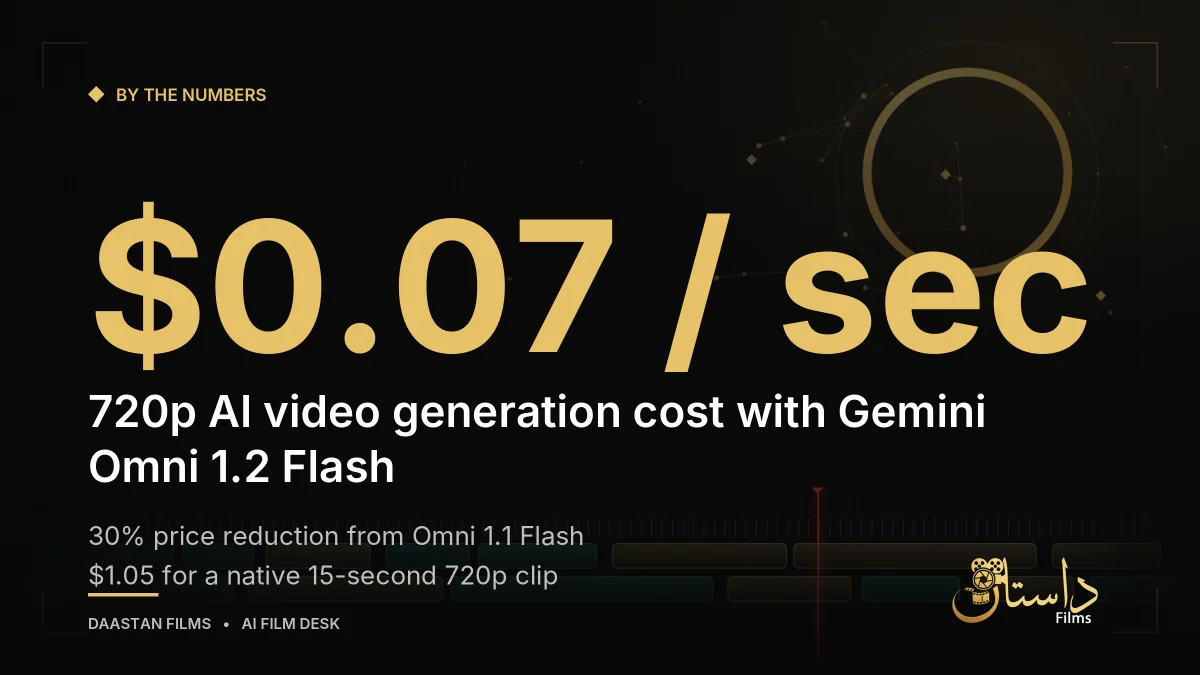
For video producers and digital studios, pricing structures in AI video generation directly dictate how deeply generative tools can be embedded into standard pre-production and production pipelines. As reported by Windows Report and MarkTechPost, Google DeepMind has reduced the API pricing for Gemini Omni 1.2 Flash to approximately $0.07 per second of 720p output, down from the roughly $0.10 per second charged for Omni 1.1 Flash. In practical terms, a full 15-second native render at 720p now costs roughly $1.05, representing a 30 percent price drop across the board.
Beyond baseline price cuts, the model introduces granular temporal control. Creators can specify video durations in precise one-second increments ranging from 3 to 15 seconds. This granularity allows production teams to tailor clip generation directly to exact commercial spot durations, social media formats, or animatic beats without paying for extra seconds of unused render time. In previous workflows, generating longer sequences required chaining short five- or ten-second clips through multi-stage extensions, which frequently introduced visual drift, morphing assets, and sudden lighting shifts.
To optimize budget allocation further, Google highlights a structured drafting and upscaling workflow. Production crews can generate rapid early drafts at 360p or 720p resolutions to evaluate scene composition, movement, and timing. Once a direction is locked and refined through iterative editing, the winning take can be upscaled to crisp 1080p or 4K output for final assembly. In high-volume production settings—such as ad agency pitch decks or rapid digital variant testing—this multi-tier rendering strategy significantly reduces total compute expenses while maintaining high resolution on final deliverables.
Stateful Multi-Turn Editing: Refining Shots Without Full Re-Renders
One of the most persistent bottlenecks in generative video workflows has been the phenomenon of prompt roulette: changing a minor background element or light source traditionally forced creators to regenerate an entire clip from scratch, often erasing favorable actor positions or camera moves in the process. Gemini Omni 1.2 Flash directly targets this issue through stateful multi-turn conversational editing, supported by Google's Interactions API.
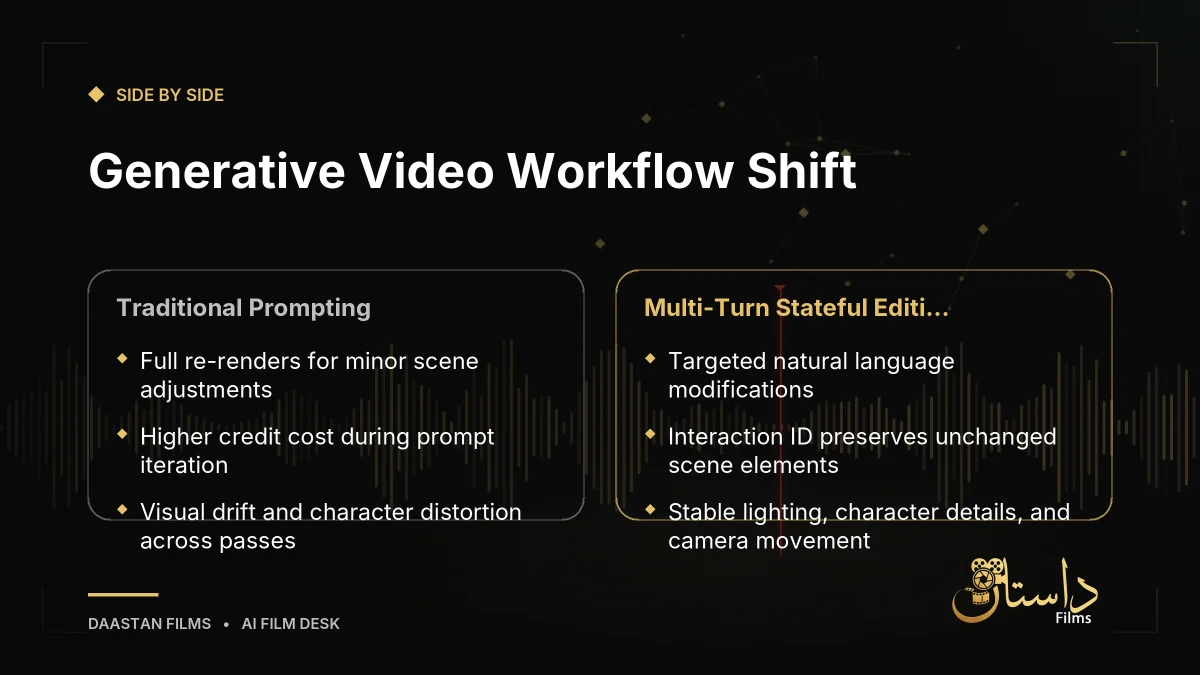
According to technical documentation covered by MarkTechPost and NokiaPowerUser, the model tracks session context using a unique interaction identifier. This architecture enables users to request incremental modifications through natural language prompts without re-uploading or re-rendering the foundational source video. A filmmaker can instruct the system to alter specific attributes—such as shifting background lighting to a golden hour sunset or swapping a blue mug on a prop desk for a ceramic coffee cup—while the underlying system holds the character's facial expression, typography, brand logos, and camera momentum steady.
This stateful modification capability extends across full 15-second sequences. For pre-visualization leads and narrative directors, this means shot continuity can be iteratively adjusted during client reviews or creative polish passes. Rather than gambling on a brand-new random seed, teams can fine-tune color grading, product placements, and environmental backdrops step by step, preserving established performances while honing individual visual details.
Visual Consistency, Camera Motion, and Audio Capabilities
Maintaining visual fidelity across scene transitions and varied camera angles remains critical for professional video applications. Google DeepMind has updated reference conditioning in Gemini Omni 1.2 Flash, allowing creators to supply up to six reference images—such as character design sheets, packaging turnarounds, or brand color swatches—alongside short motion reference clips up to three seconds long. According to reporting by NokiaPowerUser, this multi-reference input ensures that facial features, specialized garments, package text, and distinct corporate branding remain visually stable across dynamic camera maneuvers.
Camera motion controls have also been upgraded to support cinematic framing techniques. The model handles complex maneuvers like first-person view (FPV) flythroughs, orbital camera tracks, dramatic zoom-outs, and sweeping crane shots with fewer abrupt visual jumps or scale distortions. This continuity allows pre-vis artists to block out complex action beats or architectural walkthroughs with believable spatial perspective.
On the audio front, Gemini Omni 1.2 Flash operates as a fully multimodal engine that takes text, images, video clips, and audio inputs to produce synchronized video with integrated audio. The update brings improved dialogue rendering, multi-speaker conditioning, and clearer lip synchronization. Speech cadence and voice separation sound noticeably more natural, making the tool effective for dialogue-driven animatics and talking-head commercial drafts. However, developers and enterprise clients should note that custom audio reference inputs remain gated behind an allowlist on Google Cloud.
Workflow Strategies and Ecosystem Integration
Google is deploying Gemini Omni 1.2 Flash across both developer infrastructure and mainstream creative platforms. As detailed by MarkTechPost and TechBuzz, developers can access the model via Google AI Studio and the Gemini API, while enterprise deployments with dedicated service-level agreements are managed through the Google Cloud Agent Platform API. Third-party creative applications, including InVideo, QuickFrame AI, Picsart, and Photoroom, have already begun integrating the model's capabilities into their editing suites.
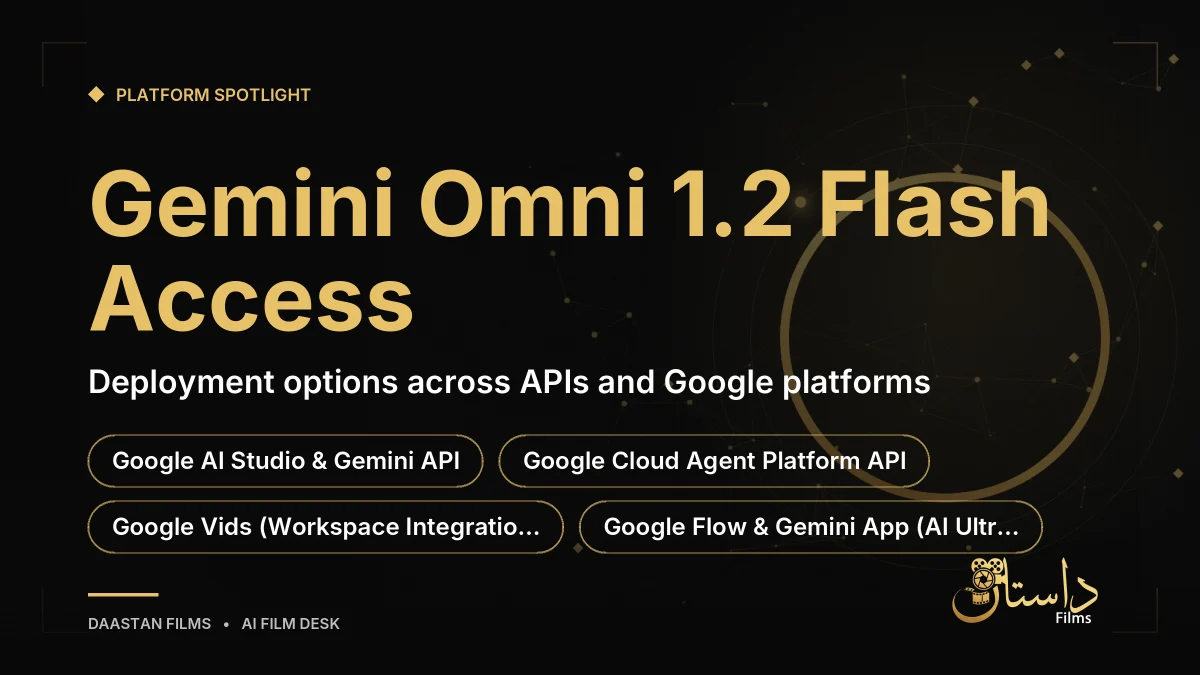
For individual creators and corporate video teams, the model is embedded directly inside Google's application ecosystem:
- Google Vids: Workspace users receive access to 15-second Omni 1.2 Flash video generation at no extra cost, expanding upon the prior 5-second restriction for presentation B-roll, training assets, and internal communications.
- Google Flow: Directors can shape scenes and adjust cinematic camera angles through direct conversational prompt chains.
- Gemini App: Rolling out for Google AI Ultra subscribers, allowing rapid video generation directly on desktop and mobile interfaces.
- Google Ads: Marketers can generate and iterate localized video ad variants directly within campaign workflows.
To assist with provenance tracking and content verification, all video outputs generated through Gemini Omni 1.2 Flash include an embedded SynthID digital watermark. Additionally, enterprise clients managing heavy rendering workloads can utilize Provisioned Throughput options to guarantee system capacity during crunch periods.
Current Limitations and Practical Cautions for Filmmakers
While Gemini Omni 1.2 Flash represents a substantial technical step forward, Google explicitly outlines several operational boundaries that filmmakers should consider before integrating the tool into main-unit production. According to MarkTechPost, the model still struggles with high-velocity sports action, rapid script pivots within a single clip, and complex multi-object physical interactions. Scenes requiring intricate kinetic interactions—such as complex martial arts choreography or liquid dynamics—may still exhibit artifacting or physics errors.
Furthermore, Google has not published formal 1.2 benchmark test scores, relying instead on side-by-side comparative demonstrations against Omni 1.1 and earlier family benchmarks, such as human-rater evaluations on MovieGenBench prompts and June text-to-video Arena rankings. Creative teams evaluating the tool for commercial use should run internal tests on specific visual assets rather than assuming universal performance parity.
It is also important to recognize deployment constraints: Gemini Omni 1.2 Flash operates exclusively as a Google-hosted model. There are no open-source weights available for local hardware deployment, meaning production pipelines must rely entirely on cloud API availability, compliance guidelines, and network connectivity. Creators must also navigate platform rights policies and ensure generated assets comply with client copyright and disclosure standards.
Conclusion
The release of Gemini Omni 1.2 Flash marks an important shift in how generative video tools fit into professional film and video workflows. By combining 15-second single-pass rendering, stateful conversational editing, tighter lip-sync, and a 30 percent cost reduction, Google provides filmmakers with a practical kit for fast pre-visualization and content creation. While physical simulation limitations mean final-frame VFX still require careful oversight, the lowered financial and technical barriers make rapid visual prototyping more accessible than ever.
Frequently asked questions
API generation costs $0.07 per second for 720p video, representing a 30 percent discount compared to Omni 1.1 Flash. A native 15-second clip costs approximately $1.05, and Workspace users can access 15-second clip generation for free inside Google Vids.
The model natively generates clips up to 15 seconds long in a single request. Users can set custom durations in exact 1-second steps between 3 and 15 seconds.
Stateful multi-turn editing lets creators modify existing video clips using natural language prompts without re-rendering the entire video. By leveraging interaction identifiers, the system preserves background lighting, camera motion, and character appearances while updating only specified objects or settings.
Have a film, DVC or AI project in mind?
Daastan Films blends production, post-production and AI. Let’s talk about yours.