When working with modern generative video models, it is very easy to assume that cheaper preview passes automatically lead to an overall cheaper project. On projects like Lost Garden, where creators often reject and regenerate numerous five-second shots, that assumption feels intuitively true at first glance. However, looking closely at the actual pricing and math reveals a different reality. According to analysis published in October 2026, draft modes in AI video generation do not make final renders cheaper; instead, they make your mistakes cheaper, and only once you have actually made one. This runs counter to how marketing around preview tiers is typically pitched, making it essential for filmmakers to understand the underlying financial mechanics.
Understanding how this workflow operates in practice requires examining multi-stage generation systems. Models like ByteDance’s Seedance 2.5—which creators can route through platforms like Higgsfield—utilize a documented two-stage workflow. Users render a locked 480p preview first, receiving a draft task identifier. That identifier can then be fed into a separate finalization step to upscale the approved take to 1080p using the identical prompt, duration, and reference images, without requiring users to re-enter settings or roll new seeds. The draft stays usable for seven days before expiring, and the approach works across text-to-video, image-to-video, and reference-to-video generations. Runway offers a similar concept through separate upscale passes rather than a single unified tier, while similar quick-pass patterns appear across tools like Midjourney, ElevenLabs, and Adobe Firefly.
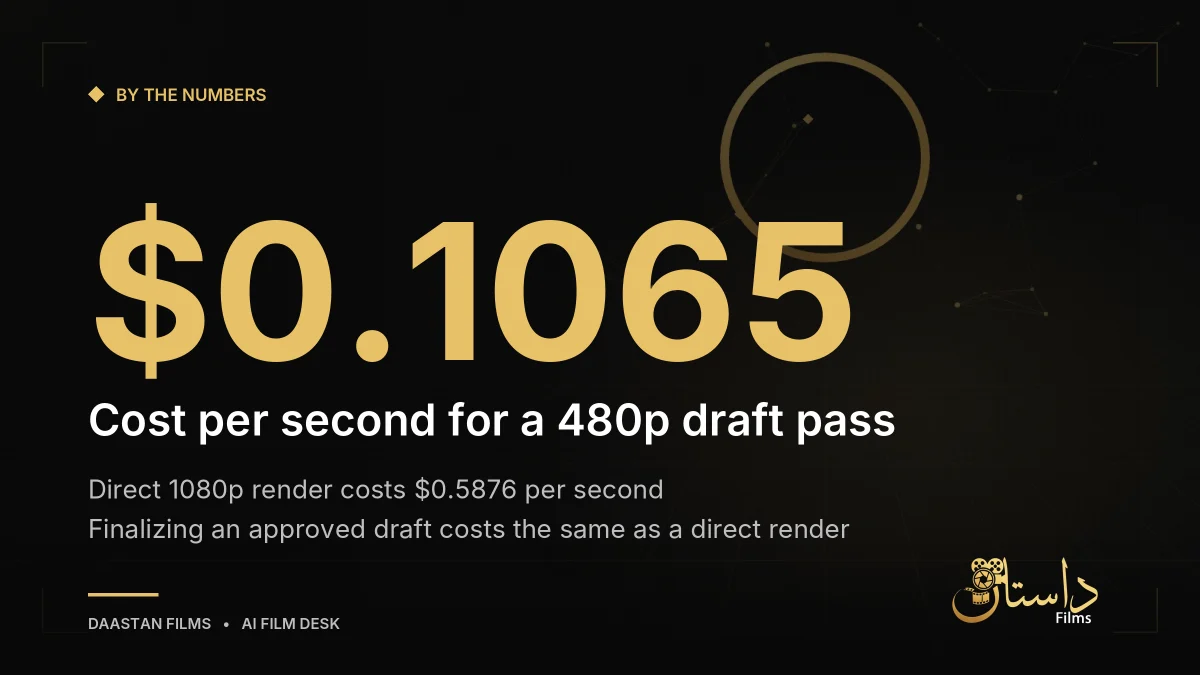
However, the financial breakdown demands careful production planning. Based on test clips and billable API calls evaluated in October 2026, a 480p draft costs $0.1065 per second, while a direct 1080p render costs $0.5876 per second. Finalizing an approved draft into high definition costs the exact same as rendering straight to 1080p, with no built-in discount for prior drafting. Consequently, if a shot succeeds on the first try, drafting first actually adds an 18% premium to your bill because you paid for the draft pass on top of the final render.
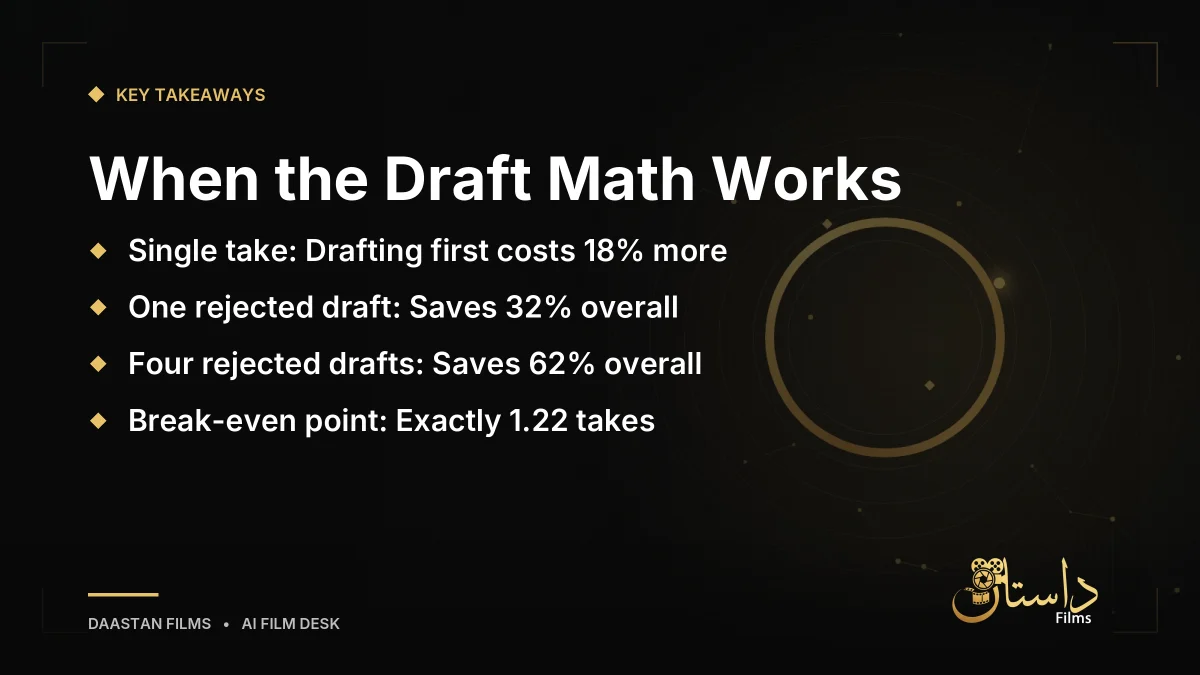
The financial benefit kicks in only when you hit errors and need multiple attempts. Rejecting a single draft and landing the correct shot on the second attempt saves 32%, while rejecting four drafts before a fifth one succeeds pushes savings to 62%. The break-even point sits at 1.22 takes. Below that threshold, drafting costs extra money; above it, avoiding full-price renders for bad takes protects your project budget. For filmmakers building automated batch scripts to run overnight, this means hardcoding a blanket "always draft first" rule into a pipeline is a costly mistake. Pipelines need to evaluate shot by shot whether a take is prone to rejection rather than relying on a universal toggle.
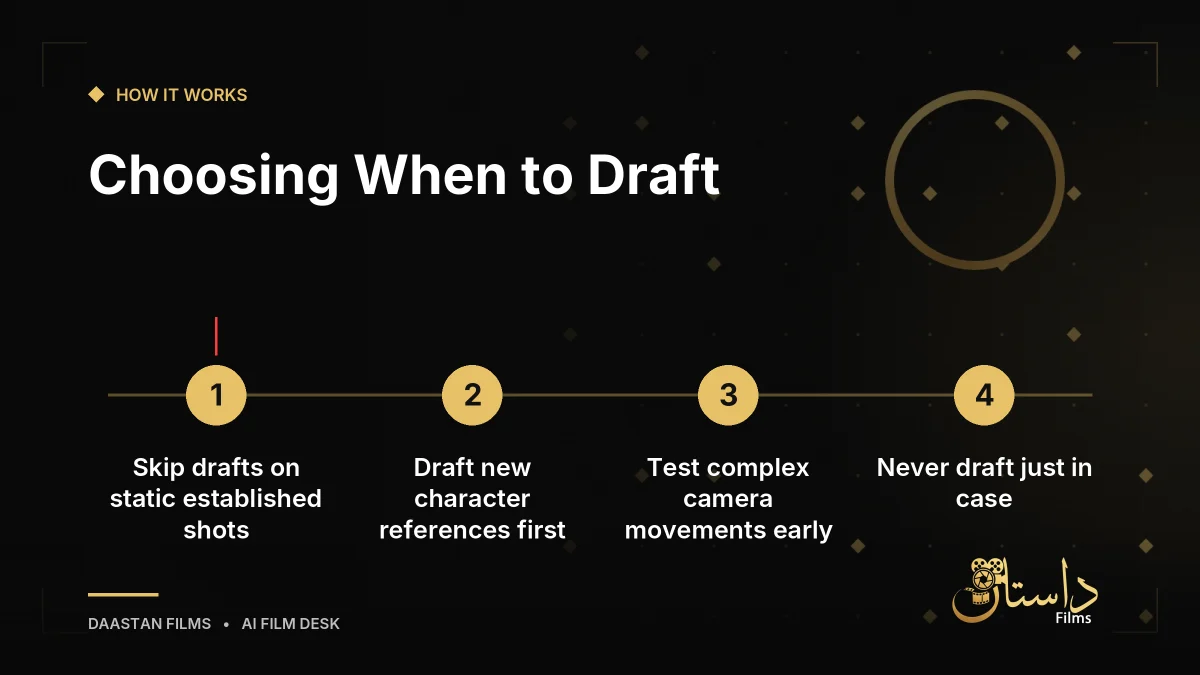
To maximize this approach in a real-world setting, creators should treat draft passes as an insurance premium rather than a default setting to leave on. Simple, static establishing shots with minimal motion do not need insurance and can be generated straight at final quality. Conversely, shots featuring untested camera movements, complex dialogue timing, or new character references benefit greatly from a 480p preview pass that allows you to check composition and timing without paying full price. Not every model exposes a named draft tier, so checking specific tool documentation is critical before mapping out a schedule.
Combining traditional pre-production discipline with modern technical workflows provides the best safeguard against inflated costs. As noted by industry practitioners, building a storyboard phase into an AI workspace—such as ScreenWeaver—ensures that camera angles, blocking, and shot durations are locked on paper before a model ever renders a single frame. A storyboard catches what the plan got wrong, which is usually the most expensive mistake, while a 480p draft catches what a text prompt got wrong. By utilizing both tools in the correct sequence, filmmakers can ensure they only pay the high cost of rendering when creative execution is thoroughly verified.
Navigating these technical decisions also requires understanding the visual trade-offs involved in reviewing low-resolution assets. While a 480p draft is entirely sufficient for evaluating composition, general motion timing, and whether character references hold up consistently, it cannot reveal fine details such as skin texture or tiny on-screen text elements. Therefore, a successful workflow balances the need for cheap iteration against the necessity of final quality verification.
Ultimately, approaching AI video production with a strategic mindset means acknowledging that no feature replaces thoughtful planning. By recognizing that draft modes insure against creative errors rather than discounting final output volume, technical directors, VFX supervisors, and independent creators can design leaner pipelines that protect budgets without sacrificing visual storytelling power.
Frequently asked questions
No. Finalizing an approved draft into 1080p costs the same as rendering straight to 1080p with no discount for having drafted first.
The break-even point sits at 1.22 takes. Below that, drafting costs more due to the added preview fee, but rejecting one or more bad takes results in net project savings.
You can effectively judge composition, timing, camera movement, and character references, though fine details like skin texture require a full upscale.
Have a film, DVC or AI project in mind?
Daastan Films blends production, post-production and AI. Let’s talk about yours.