Navigating the landscape of generative video tools requires looking closely at measurable performance metrics rather than marketing claims. According to MarkTechPost's overview of the best AI video generation models 2026, the industry leaderboard looks very different from 12 months ago. Native audio is now table stakes, clips reliably run 15 to 30 seconds, and an open-weights model officially sits in the top three.
Evaluations rely on blind human-preference Elo ratings from the Artificial Analysis Video Arena, paired with API pricing per second and the licensing status of model weights. With confidence intervals overlapping among top contenders, understanding individual platform strengths helps filmmakers select the most cost-effective and high-quality solutions for their production pipelines.
Understanding the Evaluation Metrics and Quality Signals
When analyzing the current generative video ecosystem, production teams must understand how performance is measured. Artificial Analysis ranks models by Elo from blind pairwise votes by validated evaluators, where each vote compares two clips from the same prompt using the AA-Video-T2V v2.1 and I2V v2.1 boards. Kling 3.0 1080p (Pro) is fixed as the 1000 Elo anchor on both boards. Furthermore, most top-ten scores carry a confidence interval of plus or minus 13 to 15 Elo, meaning models within roughly 25 points are statistically close and should be treated as a cluster rather than a strict order.
Pricing is another critical vector. Artificial Analysis lists cost per minute on each creator's API, normalized to 1080p where offered, and divides by 60 to establish price per second. Vendor rates at 720p are often lower, and tracking these gaps prevents unexpected budget overruns during high-volume generation runs.
For independent filmmakers, small studios, and enterprise commercial directors alike, decoding these benchmarks allows for precise allocation of resources. Rather than relying on sporadic test prompts or general industry excitement, production managers can map specific shot requirements against verified speed metrics, resolution ceilings, and regional availability. This data-driven approach ensures that creative visions are not bottlenecked by hidden rendering queues or unpredictable API expenses.
Top Text-to-Video and Image-to-Video Frontrunners
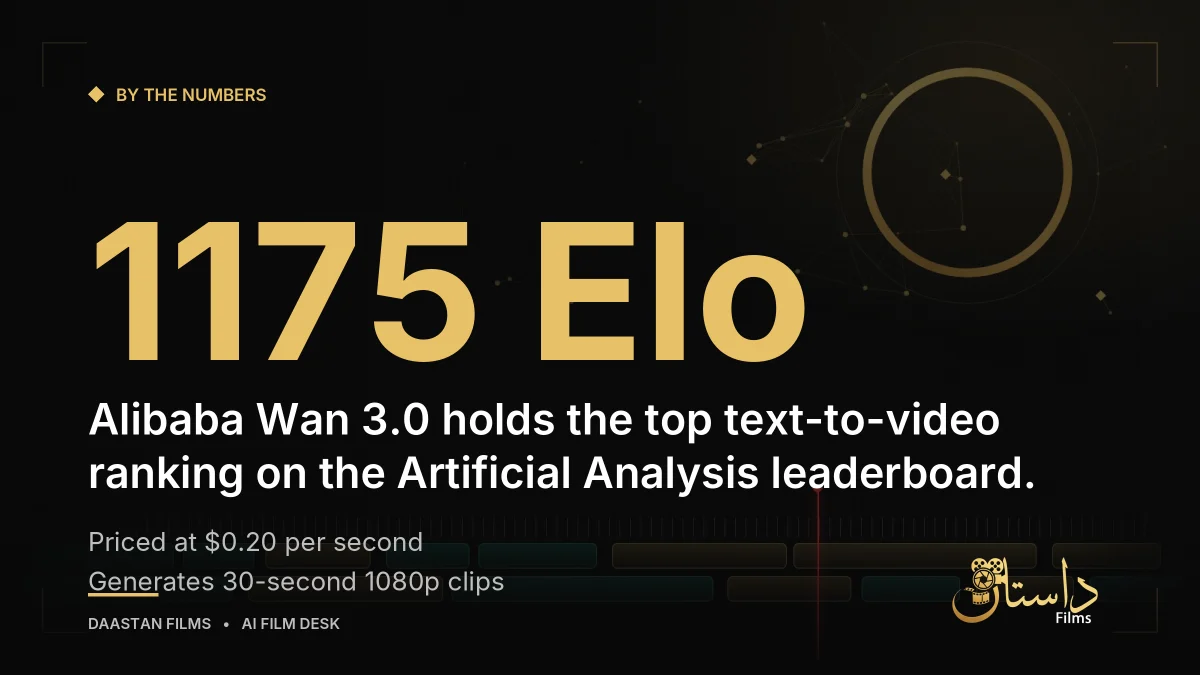
Alibaba Wan 3.0 holds the top text-to-video spot with an Elo of 1175, backed by 7,651 votes. Launched on August 24, 2026, it generates 30-second 1080p clips from text, PDFs, and slide decks, priced at $0.20 per second. Its standout feature is document-to-video input, letting creators hand it a deck and receive a structured video back. However, it offers no downloadable weights, and its image-to-video performance drops to 11th place.
For image-to-video workflows, ByteDance Dreamina Seedance 2.5 leads the board with an Elo of 1161, supporting up to 30-second generations with up to 30 image references, 10 video references, and 10 audio references. Pricing varies by provider; while Artificial Analysis lists a normalized basis of $0.569 per second, BytePlus lists a 5-second 720p clip without video input at roughly $0.23 per second, making regional access confirmation essential.
Google Gemini Omni Flash 1.2 offers a strong frontier price-to-quality ratio. Generally available since November 5, 2026, it supports 3 to 15 second clips and delivers video output for about $0.070 per second at 720p. It jumped 27 Elo points over version 1.1 on text-to-video, making it a compelling choice for teams already utilizing the Gemini API.
Open-Weights Options and Studio Integrations
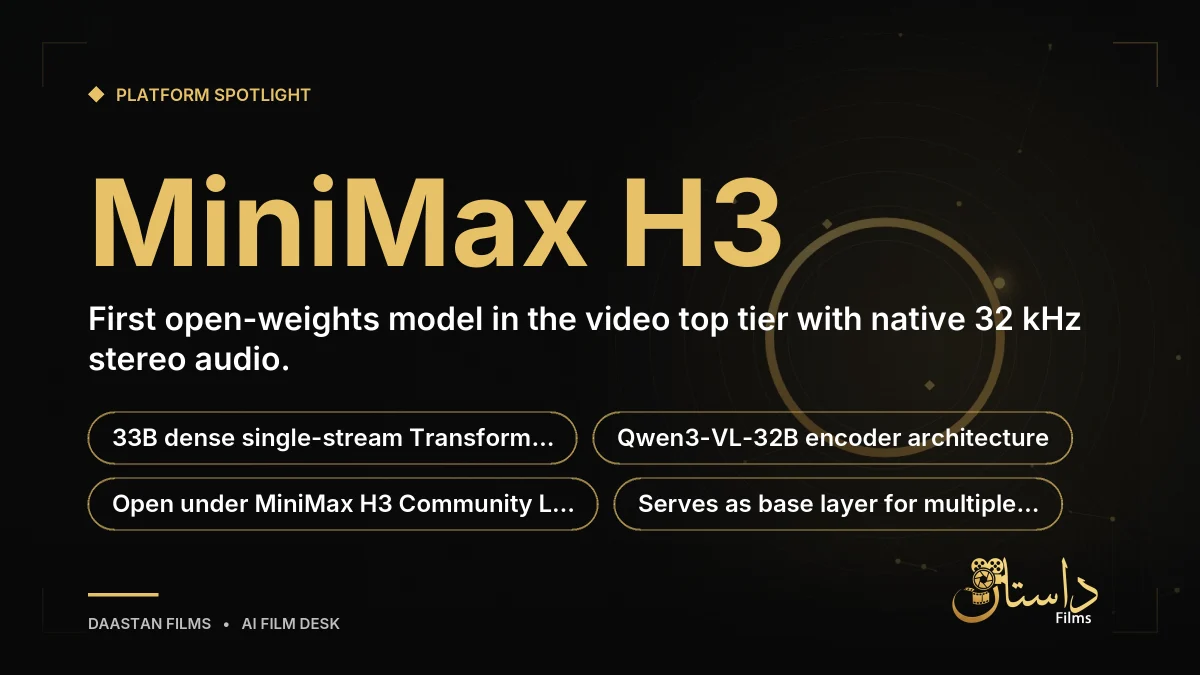
MiniMax H3 represents a major milestone as the first open-weights model in the video top tier, achieving an Elo of 1161 for text-to-video and 1133 for image-to-video. Launched via API on July 31, 2026, with weights published on August 3, it is a 33B dense single-stream Transformer using Qwen3-VL-32B as its encoder and outputting video with native 32 kHz stereo audio. Creators must review the MiniMax H3 Community License carefully, as local deployment is blocked in the US, EU, UK, and South Korea, and the open H3-Base version has a 768p resolution ceiling.
Despite these regional and resolution constraints, MiniMax H3 serves as the foundational base layer for several popular variants:
- Utopai Studios Utopai X: Built by post-training MiniMax H3, it ranks second on both text-to-video and image-to-video boards. It is accessible exclusively through Utopai's PAI platform using credit plans.
- HeyGen Video 1: A general scene generator post-trained on MiniMax H3, offering high value at $0.04 per second.
- fal H3 Max and MiniMax H3 Max: Post-trained variants focused on rapid rendering speeds and prompt adherence for fast-paced iteration.
- Pika H3 Flex and Video Rebirth HyperFlow H3: Specialized compressions designed to reduce sampling steps or run locally on standard hardware.
Speed, Licensing, and Practical Workflow Considerations
Production timelines often demand rapid iteration. fal FLUX 3 Max, post-trained by fal Research with Black Forest Labs, renders a 10-second 720p clip in about 12 seconds. Meanwhile, Black Forest Labs' flagship FLUX 3 handles both 20-second clips with native audio and robot action prediction, though it remains API-only until its open-weight Dev version ships.
Filmmakers should weigh several practical cautions when selecting a model. Pricing structures vary significantly between normalized API calculations and specific regional provider rates. Open-weight downloads carry heavy file sizes—such as the 288 GB MiniMax H3 repository divided across task-specific checkpoints—and strict territorial restrictions under community licenses. Evaluating whether a model requires pipeline access, cloud credits, or local hardware hosting ensures alignment with technical requirements and production budgets.
To approach a generative workflow successfully, production teams should first check deployment options and specs using tools like the GPULeaderboard.com chrome extension, verify exact API identifiers and regional availability, and review platform documentation before integrating a model into their editorial pipeline. Careful oversight of licensing clauses, data privacy guidelines, and compute overhead will protect productions from compliance risks while maximizing the visual fidelity of AI-assisted outputs.
Frequently asked questions
Alibaba Wan 3.0 holds the top text-to-video spot with an Elo of 1175, offering 30-second 1080p output and unique document-to-video input capabilities.
Yes, MiniMax H3 is the first open-weights model in the top tier, featuring native 32 kHz stereo audio and a 33B dense single-stream Transformer architecture, though local deployment is restricted in specific regions.
ByteDance Dreamina Seedance 2.5 leads the image-to-video leaderboard, supporting up to 30-second generations with extensive image, video, and audio references.
Have a film, DVC or AI project in mind?
Daastan Films blends production, post-production and AI. Let’s talk about yours.