Integrating artificial intelligence into video editing pipelines has historically required jumping between browser tabs, manual asset downloading, and constant file conversions. The release of Kling 4.0 Flash marks a noticeable shift in how creators approach high-frequency video generation. By opening up direct ecosystem connections and embedding generation tools straight into professional editing applications like Adobe Premiere Pro and After Effects, the model aims to eliminate friction for filmmakers, post-production teams, and commercial studios.
Ecosystem Integration: Bringing Kling 4.0 Flash to Professional NLEs
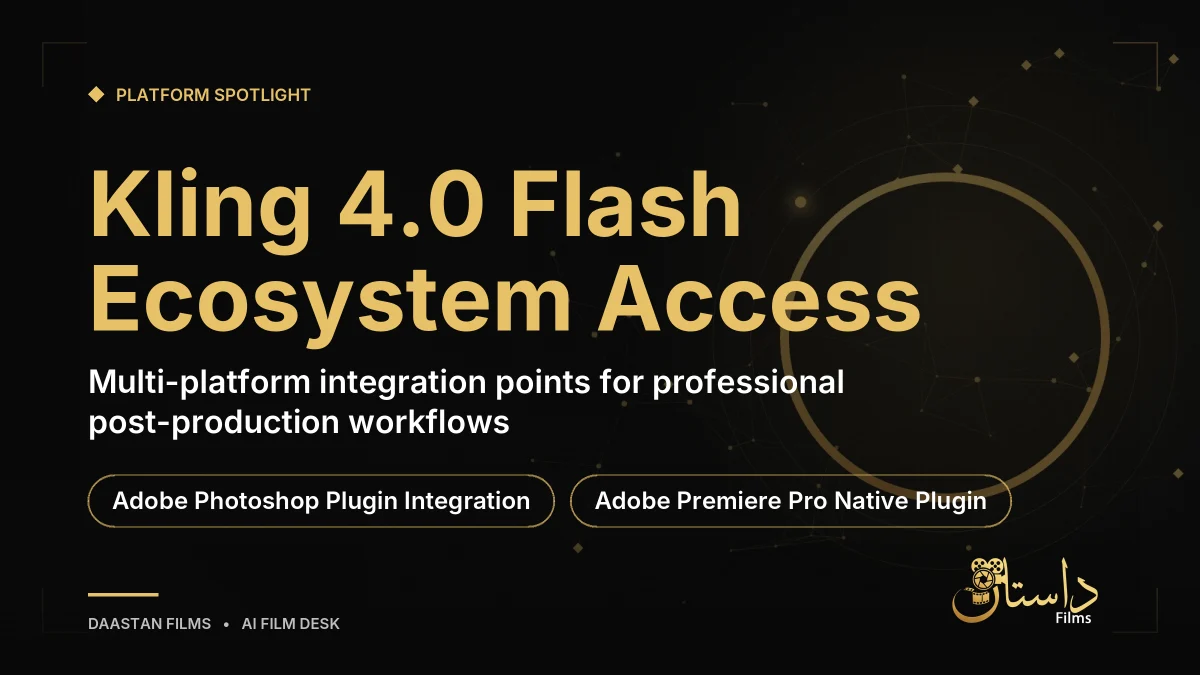
According to an announcement by AIBase, Beijing Kling has officially made its Kling 4.0 Flash model fully open to creators worldwide. Built specifically to handle high-frequency asset creation while maintaining cost-effectiveness, the model expands beyond standard web interfaces and API endpoints. It now offers multi-dimensional integration support through Model Context Protocol (MCP), Command Line Interfaces (CLI), and dedicated creative software plugins.
For post-production specialists, the most impactful element of this rollout is native plugin support for industry-standard applications including Adobe Photoshop, Premiere Pro, and After Effects. Rather than rendering video clips in an isolated external tool and manually importing them into a project timeline, editors can now initiate video generation directly within their editing workspace. This integration connects initial asset generation with fine-grained post-production, giving independent creators and commercial production houses a more cohesive environment for daily iterations and rapid storyboarding.
Mechanics of the Kling 4.0 AI Video Workflow
Beyond software plugins, understanding how to structure an efficient Kling 4.0 AI video workflow requires examining the fundamental features of the underlying model, identified as kling-v4. According to a detailed workflow study published by shattered.io, the model supports video clip generation ranging from 3 to 30 seconds per render, outputting at either 720p or 1080p resolution.
Filmmakers can feed the model several types of inputs depending on their production requirements:
- Text Prompts: Detailed text descriptions outlining visual framing, lighting, subject motion, and camera angles.
- First-Frame Prompts: Still images utilized as starting reference points to dictate initial visual composition.
- Reference Scene Prompts: Source images placed into entirely new scene environments to preserve character or object consistency.
- Clip Modifications: Tools designed to edit existing video sequences or extend clip durations seamlessly.
A defining technical capability of Kling 4.0 is its integrated multi-modal audio generation. Every generated video clip automatically arrives with a synchronous stereo audio track. Rather than requiring separate audio synthesis steps for fundamental sound effects, the model generates matching environmental audio alongside visual motion—including background crowd ambience, referee whistles, footsteps on grass, and spoken dialogue tailored to character scripts. Because generation requests are handled asynchronously, creators submit jobs to a queue and retrieve finished media when rendering is complete.
Real-World Economics and Production Speeds
To evaluate how Kling 4.0 functions under real production constraints, shattered.io conducted a practical testing scenario focused on a fictional community sports organization named Riverside FC. The objective was to generate a full package of 14 social media video clips using existing still image assets—such as team crests, ground photos, and player portraits—as visual foundations.
The total expenditure for generating all 14 test clips came out to $16.77, offering concrete financial benchmarks for small commercial studios and media teams:
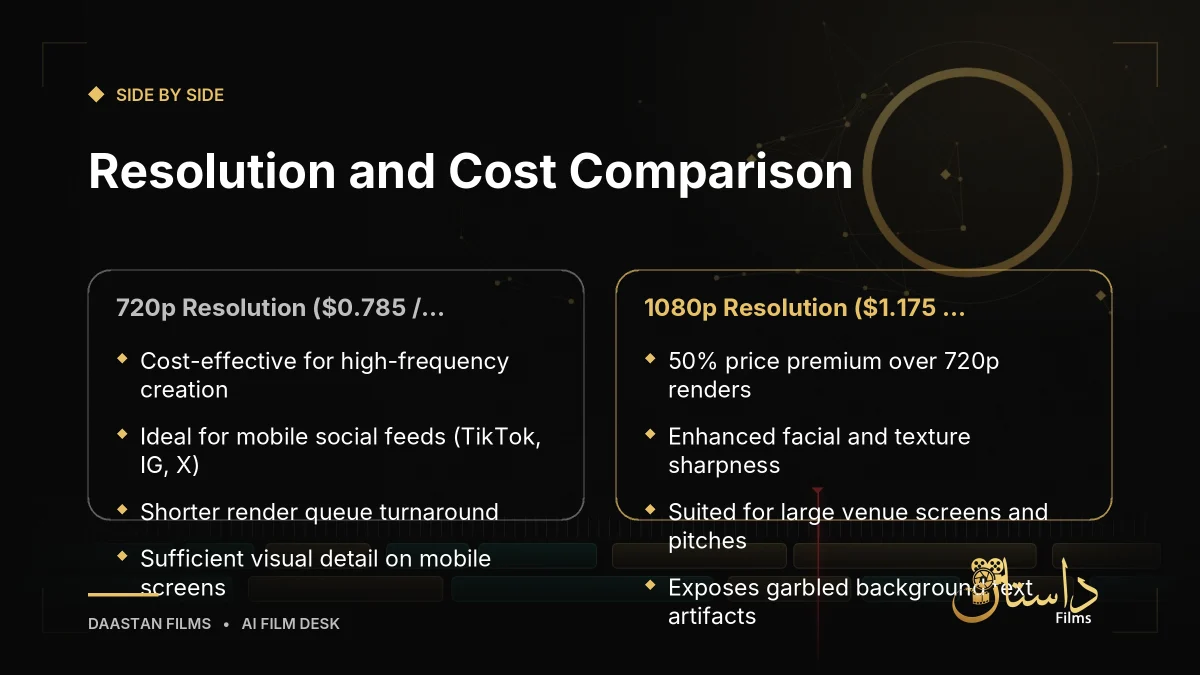
- Standard 720p Clips: A 5-second clip rendered at 720p resolution costs $0.785.
- High-Definition 1080p Clips: A 5-second clip rendered at 1080p costs $1.175, representing a 50 percent price premium over 720p.
- Extended Hype Clips: A 10-second atmospheric video clip cost $1.57.
- Animated Image Assets: An 8-second motion clip generated from a still image asset cost $1.256.
- Dialogue Shots: A 5-second character clip featuring clear spoken lines cost $0.746.
Generation turnaround times varied based on server queue volume. Individual clips required between 3 and 16 minutes to render, with the average completion time sitting around 5 minutes per job. The longest wait observed during testing was 16 minutes for a complex 10-second hype video featuring dynamic camera movements across stadium stands and field tunnels. To manage these render queues effectively without stalling active post-production sessions, creators are advised to batch-submit planned asset queues in evening sessions for morning retrieval.
When selecting output resolution, the test highlighted a clear practical distinction: 720p provides sufficient sharpness for mobile-first platforms like Instagram, TikTok, and X, where users view content on handheld screens. Higher 1080p renders are best reserved for large venue screens, client presentation decks, or high-definition broadcast master timelines.
Navigating Technical Constraints: Text, Audio, and Framing
While Kling 4.0 accelerates asset creation, practical testing reveals clear technical boundaries that filmmakers must account for during prompt construction and shot framing.
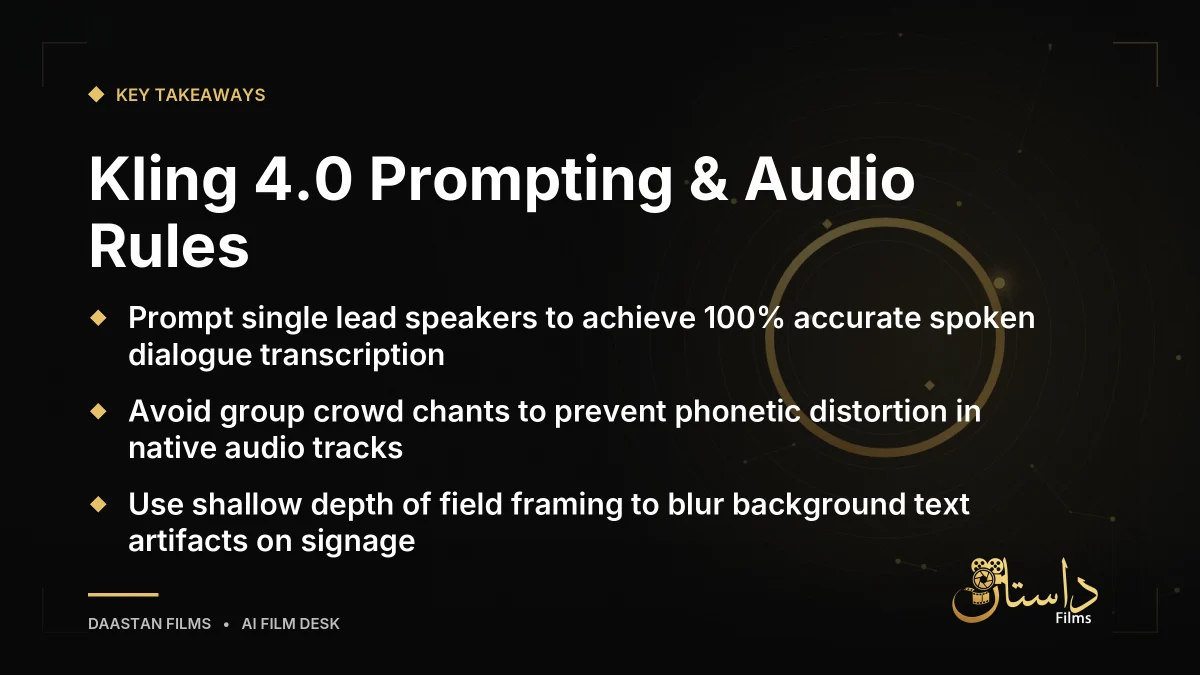
In visual renders, high-resolution 1080p outputs exposed a common generative artifact: background signage and touchline advertising boards frequently displayed scrambled, garbled lettering. For projects involving official sponsors or real-world branding, editors should deliberately compose shots with shallow depth of field to blur background elements, or frame camera angles to keep sponsorship boards entirely out of view.
Audio generation also requires structured prompt formatting. In the shattered.io study, attempting to generate a synchronized crowd chant resulted in phonetic distortion. A text prompt asking for a stand full of fans to chant "Riverside! Riverside!" produced an audio track that transcribed as "In the sky! In the sky! In the sky!". Large group vocalizations prove difficult for the sound generation engine to isolate and synthesize clearly.
To resolve this issue, the testers implemented a specific prompting workaround: framing the audio request around a single lead speaker. A revised prompt describing one fan standing up and shouting "Come on, Riverside!" followed by general crowd cheering yielded perfect speech transcription ("Come on Riverside!"). Similarly, single-voice prompts—such as a coach calling out "Quick feet, quick feet!" during a training drill, or a team captain delivering a pre-match line ("90 minutes. Everything we have got. Let us go")—produced 100 percent accurate spoken dialogue matching the written script word for word.
Market Context: Strategic Backing and Capital Investment
The rapid technological deployment and software integration of Kling AI are supported by substantial corporate capitalization. According to reporting by The Standard, parent company Kuaishou Technology announced that its Beijing Kling unit completed a fundraising round of approximately 19.8 billion yuan (US$2.98 billion).
Kuaishou retains controlling interest in the AI developer through its Lucky Labs holding vehicle, holding two-thirds of equity and 52.45 percent of voting rights. This capitalization follows a US$2.8 billion funding round completed in July 2026, which valued Beijing Kling at US$15 billion pre-money and drew backing from major technology investors including Tencent and Alibaba.
The recent 19.8 billion yuan round introduced notable institutional backing, with a unit of Kingdee International contributing 300 million yuan, Gongqingcheng Junke investing 200 million yuan, and a unit of MetaX adding 100 million yuan. As Beijing Kling continues expanding its platform ecosystem to compete directly with AI video models from OpenAI, Google, and ByteDance, sources reported by Bloomberg News indicate the company is preparing for an initial public offering (IPO) expected next year.
Implementing Kling 4.0 in Your Production Pipeline
For filmmakers and digital studios looking to build an effective Kling 4.0 AI video workflow, combining direct NLE software plugins with disciplined prompt construction provides the best balance of speed and visual consistency. Utilizing native Adobe Photoshop and Premiere Pro plugins allows editors to prototype scene ideas directly on their timeline, using initial image prompts to lock down visual continuity. When incorporating audio elements, focusing on single-speaker dialogue prompts ensures clean sound synthesis, while deliberate shot framing keeps background text artifacts from undermining project quality.
Frequently asked questions
According to AIBase, Kling 4.0 Flash features native plugins for Adobe Photoshop, Premiere Pro, and After Effects. Creators can also access generation capabilities via official APIs, Command Line Interfaces (CLI), and Model Context Protocol (MCP).
Based on hands-on testing by shattered.io, 5-second 720p clips cost $0.785, while 1080p clips cost $1.175. Individual clip generation times range between 3 and 16 minutes, with most renders completing in around 5 minutes.
Every clip includes a stereo audio track. Testing demonstrates that single-speaker dialogue prompts achieve exact transcription accuracy, whereas complex group vocalizations like crowd chants frequently produce phonetic audio distortion.
Have a film, DVC or AI project in mind?
Daastan Films blends production, post-production and AI. Let’s talk about yours.