Recent industry disclosures have shed light on how major streaming platforms are incorporating generative technologies into high-end post-production. At Turin’s View Conference, Mohsen Mousavi, Vice President of Virtual Pioneering at Netflix-owned Eyeline Studios, provided an exclusive look at how the studio integrates machine learning with conventional pipelines. According to Variety's reporting, the studio applies a philosophy it calls hybrid production, merging live-action footage, standard visual effects, and AI-assisted methodologies.
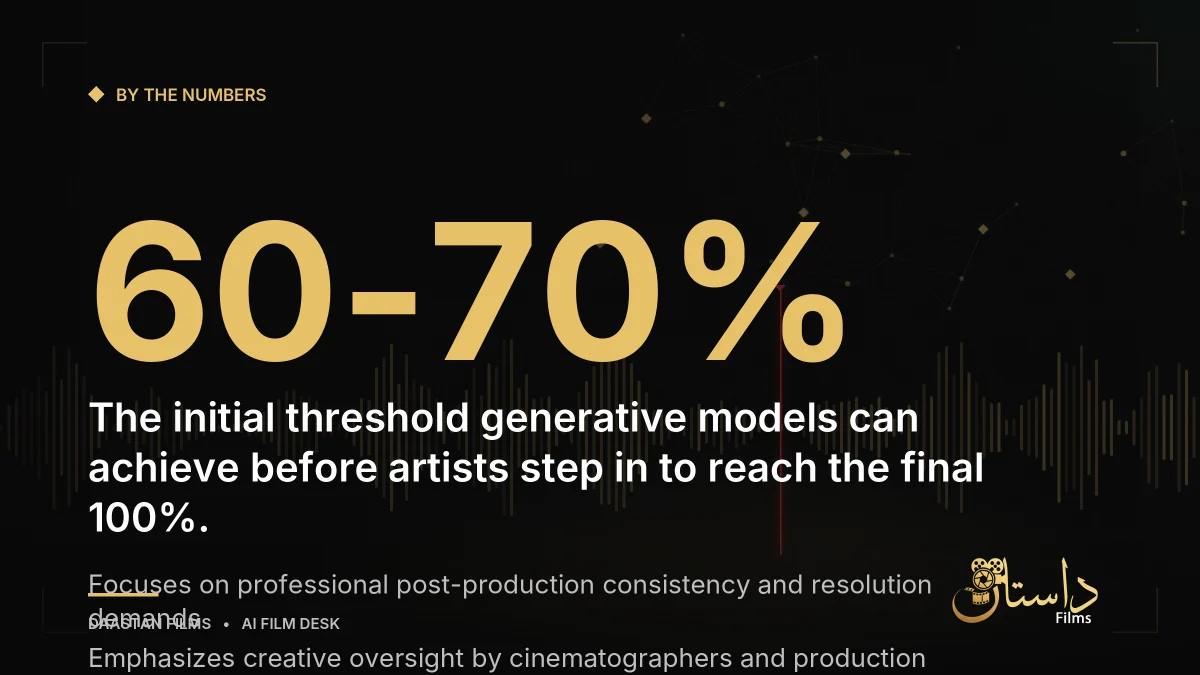
Rather than relying on automated text prompts to generate entire motion pictures, Eyeline treats machine learning as a sophisticated extension of traditional filmmaking crafts. As Mousavi noted during his presentation, generating an initial promising image using AI models only gets a production part of the way there. The crucial and difficult work lies in bridging that output to meet the strict consistency, resolution, and creative oversight demands of professional post-production. In practice, Mousavi suggested that generative models might get a production roughly sixty to seventy percent of the way there, but getting to the final one hundred percent is what matters most for professional standards. This distinction underscores why trained artists must remain central to shaping the final frames, ensuring that automated outputs align with the precise artistic vision of directors and cinematographers.
Early Design and Sparse Set Workflows
The studio's integration of generative techniques begins long before cameras roll on set. Eyeline’s generative art department works side-by-side with conventional artists during the initial design phases to explore concepts. This collaborative environment feeds into what the studio terms sparse set workflows, allowing physical production to operate efficiently without needing fully constructed environments immediately on stage.
Under this approach, performers act on partial physical sets illuminated by relatively flat lighting. Digital tools are subsequently deployed to rebuild the surrounding environments and adjust lighting conditions while strictly preserving the actors' original performances. Mousavi emphasized that this method serves as an extension of the traditional art department rather than its replacement, ensuring that cinematographers and production designers retain hands-on control over the visual output.
For independent filmmakers and growing visual effects houses looking to analyze these workflows, understanding the balance between automated output and human artistry is essential. When approaching hybrid production concepts, creators must weigh several strategic questions. First, consider how early department collaboration can guide technological implementation without losing the unique touch of physical art design. Second, evaluate whether your pipeline allows for human artists to actively steer the digital tools rather than relying on unguided systems. Third, assess your project's readiness to handle higher finishing demands, such as resolving temporal consistency and high dynamic range challenges before delivery. Exploring these factors helps production teams avoid treating computational tools as an opaque black box, keeping human oversight at the forefront of every creative decision.
Volumetric Capture and Production Implementations
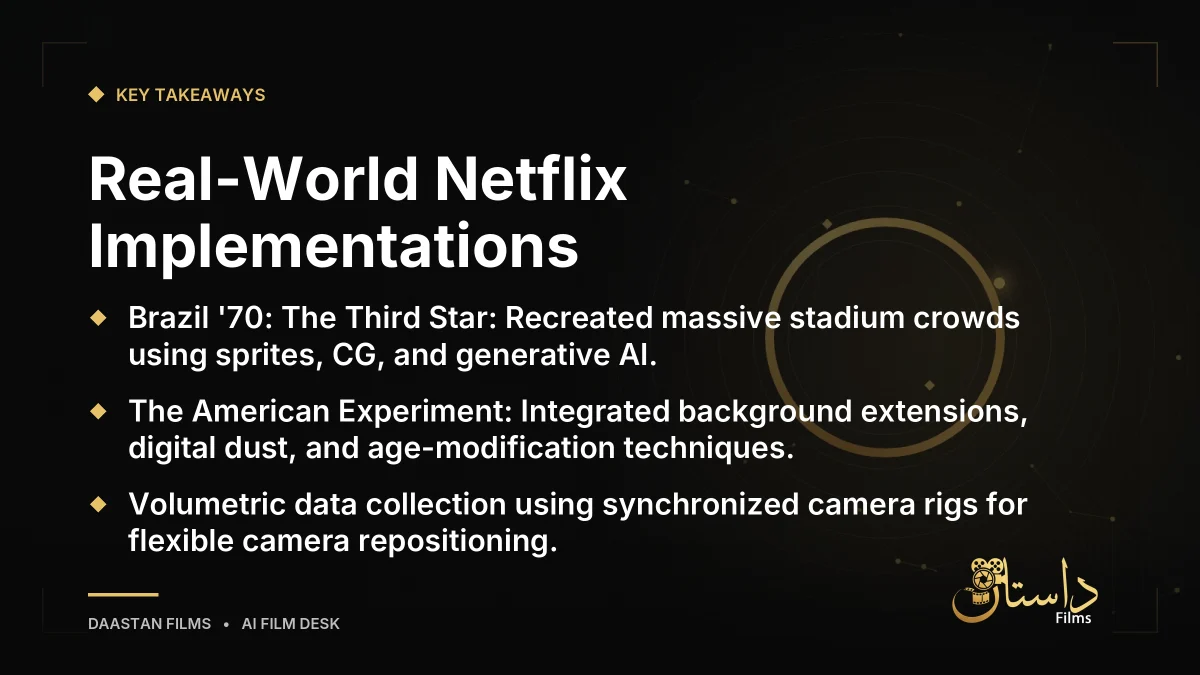
Eyeline has also experimented extensively with volumetric capture systems that grant filmmakers remarkable post-shoot flexibility. Demonstrations at the conference showcased footage recorded in a single location being entirely transformed into another environment without depending on green screens. This grants creators freedom of light and freedom of camera placement after the acting performances have already been safely captured.
Elements of these approaches have already seen deployment across real Netflix titles. For instance, on the drama Brazil ’70: The Third Star, which follows the national team's 1970 World Cup victory, Eyeline utilized a mixture of filmed elements, sprites, conventional CG, and generative techniques to recreate massive, responsive stadium crowds. Mousavi explained that relying entirely on traditional visual effects for these crowds would have heavily strained the production budget, making the hybrid approach a practical necessity for ambitious historical storytelling.
Similarly, on the five-part historical documentary The American Experiment, the studio integrated background extensions, digital dust, and other constructed elements with practical footage. The team also demonstrated methods for adjusting a performer’s apparent age while leaving the foundational acting untouched. These practical implementations highlight how targeted technological additions can solve complex budgetary and logistical hurdles without compromising the integrity of the live performance captured on set.
Current Research and Practical Challenges
Looking toward future pipelines, Eyeline is heavily invested in proprietary research rather than off-the-shelf software. The studio uses specialized capture setups—such as a system utilizing forty synchronized RED V-Raptor cameras—aside from portable hardware to gather unique training data. Current research directions include building navigable 4D scenes from single-camera recordings and creating controllable fluid simulations that give artists precise authority over physical elements.
Fluid dynamics, particularly water, remain a major hurdle because current models are non-deterministic and difficult to manage. Eyeline aims to build tools that let artists independently adjust water velocity, thickness, and turbulence, or add foam and spray, allowing them to intentionally break physical realism for specific creative goals. This level of granular control is vital for achieving unique cinematic moments that standard physics engines alone might fail to produce reliably.
Despite these advancements, significant technical bottlenecks persist. Maintaining high dynamic range, crisp 4K finishing, and reliable temporal consistency across frames require constant refinement. Ultimately, the guiding principle at Eyeline is to avoid treating artificial intelligence as an opaque black box, striving instead for completely cohesive results where the viewer cannot distinguish whether an image originated from a physical camera, standard computer graphics, or generative technology.
When examining how these practices impact the broader industry, creators should check official documentation and technical guidelines as methods evolve. While large studios like Netflix possess the resources to build proprietary models and custom multi-camera arrays, independent creators can still apply the core philosophical takeaways outlined by Mousavi at the View Conference: prioritize artist control, integrate digital enhancements early in the design phase, and treat computational tools as collaborative extensions of the traditional art department rather than replacements for human creativity.
Frequently asked questions
Hybrid production is an approach described by VP Mohsen Mousavi that combines live-action photography, conventional visual effects, and generative AI workflows to build and enhance scenes.
The studio helped recreate massive stadium crowds required for the 1970 World Cup drama by combining filmed elements, sprites, conventional CG, and generative techniques within budget constraints.
Key challenges include maintaining high dynamic range, achieving crisp 4K finishing, and ensuring temporal consistency between video frames, alongside controlling non-deterministic elements like fluid simulations.
Have a film, DVC or AI project in mind?
Daastan Films blends production, post-production and AI. Let’s talk about yours.